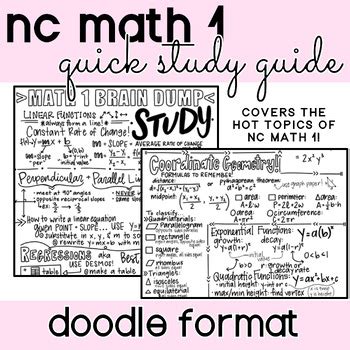
If you’re currently enrolled in NC Math 1 or preparing to enroll in the future, this comprehensive guide will provide you with all the essential information and strategies you need to excel in the course.

Understanding NC Math 1
NC Math 1 is a high school algebra course that covers a wide range of topics, including:
- Linear equations and inequalities
- Functions and graphing
- Systems of equations and inequalities
- Exponents and radicals
- Rational expressions
- Quadratic equations and functions
- Exponential and logarithmic functions
The course is designed to build upon students’ previous knowledge of mathematics and prepare them for more advanced math courses such as Algebra 2 and Pre-Calculus.
Benefits of NC Math 1
Taking NC Math 1 offers numerous benefits for students, including:
- Improved problem-solving skills: Algebra teaches students how to analyze and solve complex problems using logical reasoning.
- Enhanced critical thinking: The course requires students to think critically about mathematical concepts and apply them to real-world situations.
- Preparation for higher education: NC Math 1 is a prerequisite for many college-level math courses.
- Increased career opportunities: A strong foundation in algebra is essential for many careers in fields such as science, technology, engineering, and finance.
Common Mistakes to Avoid
To maximize your success in NC Math 1, it’s crucial to avoid common mistakes such as:
- Lack of practice: Regular practice is essential for mastering algebra skills. Don’t cram for tests; instead, dedicate time to solving problems consistently.
- Memorization without understanding: Don’t simply memorize formulas and concepts. Make sure you understand why they work and how to apply them in different situations.
- Ignoring the importance of graphs: Graphs play a vital role in visualizing and understanding algebraic relationships. Don’t neglect their use in solving problems.
- Hesitation to ask for help: If you’re struggling with a concept, don’t hesitate to ask your teacher or a classmate for help. Seeking clarification can make a significant difference in your understanding.
Strategies for Success
To achieve success in NC Math 1, consider implementing the following strategies:
- Attend class regularly: Consistent attendance is key to keeping up with the pace of the course and understanding the concepts covered in class.
- Complete assignments on time: Assignments provide opportunities to practice and reinforce the material you’re learning. Don’t fall behind on homework.
- Study effectively: Focus on understanding concepts rather than memorizing formulas. Use flashcards, create concept maps, and engage in active recall to enhance your retention.
- Seek help when needed: If you encounter difficulties, don’t hesitate to ask for assistance from your teacher, a tutor, or a classmate.
- Utilize online resources: Many free online resources are available to enhance your learning, such as Khan Academy, Mathway, and Wolfram Alpha.
NC Math 1 Course Outline
The NC Math 1 course outline typically covers the following modules:
Module 1: Expressions and Equations
- Algebraic expressions and operations
- Solving linear equations
- Solving systems of linear equations
Module 2: Functions
- Graphing linear functions
- Writing linear equations from graphs
- Linear inequalities
Module 3: Exponents and Radicals
- Exponents and radicals
- Scientific notation
- Rational exponents
Module 4: Polynomials
- Polynomials and operations
- Factoring polynomials
- Solving polynomial equations
Module 5: Rational Expressions
- Rational expressions and operations
- Solving rational equations
- Applications of rational expressions
Module 6: Quadratic Equations
- Graphing quadratic functions
- Solving quadratic equations
- Applications of quadratic equations
Module 7: Exponential and Logarithmic Functions
- Exponential functions
- Logarithmic functions
- Solving exponential and logarithmic equations
Who should take NC Math 1?
NC Math 1 is a course typically taken by high school students in North Carolina. It is a prerequisite for many college-level math courses, so it is important for students who plan to pursue higher education to take this course.
What are the prerequisites for NC Math 1?
The prerequisites for NC Math 1 vary depending on the school district. However, most schools require students to have successfully completed a pre-algebra or Algebra I course before taking NC Math 1.
What are the benefits of taking NC Math 1?
There are many benefits to taking NC Math 1. Some of these benefits include:
- Improved problem-solving skills: Algebra teaches students how to analyze and solve complex problems using logical reasoning.
- Enhanced critical thinking: The course requires students to think critically about mathematical concepts and apply them to real-world situations.
- Preparation for higher education: NC Math 1 is a prerequisite for many college-level math courses.
- Increased career opportunities: A strong foundation in algebra is essential for many careers in fields such as science, technology, engineering, and finance.
What are the common mistakes to avoid when taking NC Math 1?
There are a few common mistakes that students make when taking NC Math 1. These mistakes include:
- Lack of practice: Regular practice is essential for mastering algebra skills. Don’t cram for tests; instead, dedicate time to solving problems consistently.
- Memorization without understanding: Don’t simply memorize formulas and concepts. Make sure you understand why they work and how to apply them in different situations.
- Ignoring the importance of graphs: Graphs play a vital role in visualizing and understanding algebraic relationships. Don’t neglect their use in solving problems.
- Hesitation to ask for help: If you’re struggling with a concept, don’t hesitate to ask your teacher or a classmate for help. Seeking clarification can make a significant difference in your understanding.
What are some strategies for success in NC Math 1?
There are a few strategies that students can use to improve their chances of success in NC Math 1. These strategies include:
- Attend class regularly: Consistent attendance is key to keeping up with the pace of the course and understanding the concepts covered in class.
- Complete assignments on time: Assignments provide opportunities to practice and reinforce the material you’re learning. Don’t fall behind on homework.
- Study effectively: Focus on understanding concepts rather than memorizing formulas. Use flashcards, create concept maps, and engage in active recall to enhance your retention.
- Seek help when needed: If you encounter difficulties, don’t hesitate to ask for assistance from your teacher, a tutor, or a classmate.
- Utilize online resources: Many free online resources are available to enhance your learning, such as Khan Academy, Mathway, and Wolfram Alpha.
How do I prepare for the NC Math 1 End-of-Course Test?
The NC Math 1 End-of-Course Test is a standardized test that all students in North Carolina must take at the end of the NC Math 1 course. The test is designed to measure students’ understanding of the concepts and skills covered in the course.Students can prepare for the NC Math 1 End-of-Course Test by:
- Studying the course material: Make sure you have a good understanding of all the concepts and skills covered in the course.
- Taking practice tests: There are many practice tests available online and in textbooks. Taking practice tests can help you get familiar with the format of the test and identify areas where you need to improve.
- Getting help from your teacher or a tutor: If you’re struggling with a concept, don’t hesitate to ask your teacher or a tutor for help. They can provide you with additional explanations and practice problems.
- Getting a good night’s sleep before the test: Make sure you get a good night’s sleep before the test so that you’re well-rested and ready to perform your best.
What are the career opportunities for students who take NC Math 1?
There are many career opportunities for students who take NC Math 1. Some of these careers include:
- Actuary: Actuaries use math to assess risk and uncertainty. They work in a variety of industries, including insurance, finance, and healthcare.
- Data analyst: Data analysts use math to analyze data and identify trends. They work in a variety of industries, including marketing, healthcare, and finance.
- Engineer: Engineers use math to design and build things. They work in a variety of industries, including construction, manufacturing, and transportation.
- Financial analyst: Financial analysts use math to analyze financial data and make investment recommendations. They work in a variety of industries, including banking, investment management, and insurance.
- Operations research analyst: Operations research analysts use math to solve problems in business and industry. They work in a variety of industries, including manufacturing, logistics, and healthcare.
- Statistician: Statisticians use math to collect, analyze, and interpret data. They work in a variety of industries, including healthcare, education, and government.
What are the salary expectations for students who take NC Math 1?
The salary expectations for students who take NC Math 1 vary depending on the career they choose. However, some general salary figures for some of the careers listed above include:
- Actuary: The median annual salary for actuaries is $111,560.
- Data analyst: The median annual salary for data analysts is $65,650.
- Engineer: The median annual salary for