Introduction
Algebra 2 is the second part of a two-part series of courses that cover the fundamentals of mathematics. It builds upon the concepts learned in Algebra 1 by introducing new topics and expanding upon existing ones. Algebra 2 is used in many disciplines, such as geometry, trigonometry, and statistics.
What is Algebra 2?
Algebra 2 is a branch of mathematics that deals with solving equations and inequalities. It also involves the study of functions, matrices, and polynomials. Algebra 2 is used in many different fields, such as engineering, physics, and economics.
Why is Algebra 2 important?
Algebra 2 is an important subject because it provides a foundation for higher-level mathematics courses. It also helps students develop problem-solving skills and critical thinking skills. Algebra 2 is a challenging subject, but it is also very rewarding. With a solid understanding of Algebra 2, students will be prepared for success in future mathematics courses and in the workplace.
Common Mistakes to Avoid
There are a few common mistakes that students make in Algebra 2. These mistakes include:
- Not understanding the order of operations.
- Making careless errors when simplifying expressions.
- Not understanding how to solve equations and inequalities.
- Not understanding the concept of a function.
- Not understanding how to graph functions.
Tips for Success
Here are a few tips for success in Algebra 2:
- Pay attention in class and take good notes.
- Do your homework regularly.
- Ask your teacher for help when you don’t understand something.
- Study for tests and quizzes.
- Form a study group with other students.
- Use online resources to help you learn.
Applications of Algebra 2
Algebra 2 is used in a variety of fields, such as:
- Engineering
- Physics
- Economics
- Computer science
- Finance
Algebra 2 is a powerful tool that can be used to solve problems and make predictions. With a solid understanding of Algebra 2, you will be prepared for success in college, career, and life.
Conclusion
Algebra 2 is a challenging but important subject. With a solid understanding of Algebra 2, you will be prepared for success in future mathematics courses and in the workplace.
Linear Equations
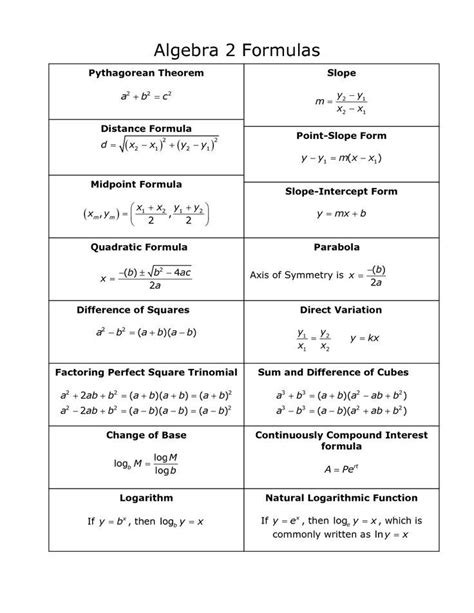
- Slope-intercept form: y = mx + b
- Point-slope form: y – y1 = m(x – x1)
- Standard form: Ax + By = C
Quadratic Equations
- Quadratic formula: x = (-b ± √(b^2 – 4ac)) / 2a
- Factoring: (ax + b)(cx + d) = acx^2 + (ad + bc)x + bd
Polynomials
- Degree: The highest exponent of the variable
- Leading coefficient: The coefficient of the term with the highest exponent
- Constant term: The term with no variable
Functions
- Domain: The set of all possible input values
- Range: The set of all possible output values
- Inverse function: A function that undoes another function
Matrices
- Determinant: A number that is associated with a matrix
- Inverse matrix: A matrix that, when multiplied by the original matrix, gives the identity matrix
Systems of Equations
- Substitution method: Solve one equation for a variable and substitute it into the other equation.
- Elimination method: Add or subtract the equations to eliminate one variable.
Inequalities
- Linear inequalities: Ax + B > C or Ax + B < C
- Quadratic inequalities: ax^2 + bx + c > 0 or ax^2 + bx + c < 0
Trigonometry
- Sine: sin(x) = opposite / hypotenuse
- Cosine: cos(x) = adjacent / hypotenuse
- Tangent: tan(x) = opposite / adjacent
Logarithms
- Logarithm of a product: log(ab) = log(a) + log(b)
- Logarithm of a quotient: log(a / b) = log(a) – log(b)
- Change of base formula: logx(a) = logb(a) / logb(x)
Other Formulas
- Distance formula: d = √((x2 – x1)^2 + (y2 – y1)^2)
- Midpoint formula: ((x1 + x2) / 2, (y1 + y2) / 2)
- Slope formula: m = (y2 – y1) / (x2 – x1)
- Area of a triangle: A = (1 / 2) * base * height
- Area of a circle: A = πr^2
- Volume of a sphere: V = (4 / 3) * πr^3
- Pythagorean theorem: a^2 + b^2 = c^2
Table of Linear Equation Forms
| Form | Equation | Description |
|---|---|---|
| Slope-intercept form | y = mx + b | y-intercept is b, slope is m |
| Point-slope form | y – y1 = m(x – x1) | Passes through the point (x1, y1) with slope m |
| Standard form | Ax + By = C | y-intercept is -C/B, x-intercept is -A/B |
Table of Quadratic Equations
| Equation | Form | Description |
|---|---|---|
| ax^2 + bx + c = 0 | Standard form | Has two solutions, given by the quadratic formula |
| (ax + b)(cx + d) = 0 | Factored form | Has two solutions, given by x = -b/a and x = -d/c |
| y = a(x – h)^2 + k | Vertex form | Has a vertex at (h, k) and opens up or down based on the sign of a |
Table of Trigonometric Functions
| Function | Definition | Range |
|---|---|---|
| Sine | sin(x) = opposite / hypotenuse | [-1, 1] |
| Cosine | cos(x) = adjacent / hypotenuse | [-1, 1] |
| Tangent | tan(x) = opposite / adjacent | (-∞, ∞) |
Table of Logarithmic Functions
| Equation | Description | Domain | Range |
|---|---|---|---|
| logx(a) = y | x = a^y | (0, ∞) | (∞, -∞) |
| ln(x) = y | e^y = x | (0, ∞) | (∞, -∞) |
| logb(a) = y | b^y = a | (0, ∞) | (∞, -∞) |