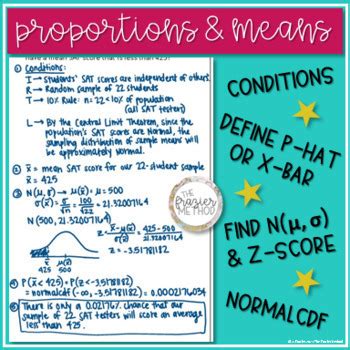
Are you ready to conquer the final frontier of AP Statistics? Unit 5 is where the rubber meets the road, as you’ll put all your newfound knowledge to work on real-world data analysis. This thorough review will provide you with a comprehensive guide to help you ace this challenging unit.
Hypothesis Testing: The Cornerstone of Statistical Inference
Hypothesis testing is the backbone of statistical inference, allowing you to make informed decisions about populations based on sample data.
Key Concepts:
- Null Hypothesis (H0): Assumes no significant difference exists.
- Alternative Hypothesis (H1): Assumes a significant difference exists.
- Type I Error (α): Rejecting H0 when it’s true (False Positive).
- Type II Error (β): Failing to reject H0 when it’s false (False Negative).
Steps:
- State the hypotheses (H0 and H1).
- Set the significance level (α).
- Calculate the test statistic.
- Find the critical value.
- Make a decision: Reject H0 if the test statistic exceeds the critical value, otherwise fail to reject H0.
Chi-Square Tests: Analyzing Categorical Data
Chi-square tests are essential for analyzing the relationship between two or more categorical variables.
Applications:
- Testing independence of categories.
- Comparing proportions in two or more categories.
- Detecting goodness-of-fit to a theoretical distribution.
Formula: χ2 = ∑[(Oi – Ei)2 / Ei], where:
- Oi = Observed frequency in category i.
- Ei = Expected frequency in category i.
Confidence Intervals: Estimating Population Parameters
Confidence intervals provide a range of plausible values for population parameters based on sample data.
Key Concepts:
- Confidence Level: The probability that the confidence interval contains the true parameter value.
- Confidence Interval: The range of values within which the true parameter value is expected to fall.
Formula:
- For mean: x̄ ± Zc * (s/√n), where x̄ is the sample mean, s is the sample standard deviation, n is the sample size, and Zc is the critical value from the standard normal distribution.
- For proportion: p̂ ± Zc * √(p̂(1-p̂)/n), where p̂ is the sample proportion.
Linear Regression: Modeling Relationships
Linear regression establishes a linear relationship between two variables, predicting the value of one variable based on the other.
Key Concepts:
- Regression Line: The line that best fits the data points.
- Slope: The change in the predicted value for a one-unit change in the independent variable.
- Intercept: The value of the dependent variable when the independent variable is zero.
- Correlation Coefficient: A measure of the strength and direction of the linear relationship.
Formula: y = mx + b, where:
- y is the predicted value of the dependent variable.
- x is the value of the independent variable.
- m is the slope.
- b is the intercept.
Analysis of Variance (ANOVA): Comparing Group Means
ANOVA determines whether there are statistically significant differences between the means of multiple groups.
Applications:
- Comparing means of two or more independent groups (One-Way ANOVA).
- Comparing means of two or more dependent groups (Repeated Measures ANOVA).
Steps:
- State the hypotheses (H0 and H1).
- Calculate the test statistic (F-statistic).
- Find the critical value.
- Make a decision: Reject H0 if the F-statistic exceeds the critical value, otherwise fail to reject H0.
Conclusion
AP Statistics Unit 5 is a culmination of your statistical learning, requiring you to apply your knowledge to real-world problems. By mastering the concepts covered in this review, you’ll be well-equipped to navigate the challenges of hypothesis testing, chi-square tests, confidence intervals, linear regression, and ANOVA. Embrace the rigor of Unit 5, and you’ll emerge with a deep understanding of statistical inference.
Effective Strategies for Succeeding in Unit 5
- Practice the Fundamentals: Strengthen your understanding by practicing various problems from each topic.
- Understand the Concepts: Focus on grasping the underlying principles rather than just memorizing formulas.
- Apply to Real-World Data: Use real-world examples to understand how statistical methods are used in practice.
- Collaborate with Others: Study with peers, ask questions, and discuss concepts to enhance your comprehension.
- Seek Help When Needed: Don’t hesitate to seek assistance from your teacher, tutor, or classmates if you encounter challenges.
Tips and Tricks for Unit 5 Success
- Use a Step-by-Step Approach: Break down complex problems into smaller, manageable steps.
- Interpret P-Values Correctly: P-values measure the probability of observing a result as extreme or more extreme if H0 is true.
- Consider Effect Size: Examine not only statistical significance but also the practical significance of your results.
- Check Model Assumptions: Ensure that data meets the assumptions of the statistical techniques you’re using.
- Communicate Clearly and Effectively: Present your findings in a clear and concise manner, using appropriate statistical terminology.
Useful Tables for Unit 5 Review
| Table | Description |
|---|---|
| Table 1 | Critical Values for the Standard Normal Distribution |
| Table 2 | Critical Values for the Chi-Square Distribution |
| Table 3 | Critical Values for the Student’s t-Distribution |
| Table 4 | ANOVA Summary Table |
Additional Resources
- AP Statistics Course Description and Exam Information: https://apcentral.collegeboard.org/courses/ap-statistics
- Khan Academy AP Statistics Unit 5: https://www.khanacademy.org/math/ap-statistics/ap-probability-and-sampling-distributions
- The 5 Levels of Statistical Significance: https://www.investopedia.com/terms/s/statisticalsignificance.asp