Introduction
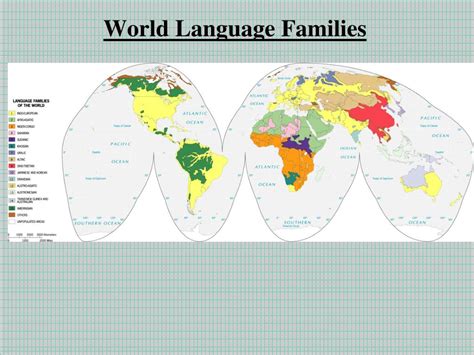
Language is a fundamental aspect of human societies, shaping our communication, identity, and worldview. Within the vast tapestry of languages spoken around the globe, there exist distinct groupings known as language families. These families represent languages that share a common ancestor and exhibit similarities in grammar, vocabulary, and pronunciation. Understanding language families plays a critical role in AP Human Geography, providing insights into the historical migrations, cultural interactions, and linguistic diversity that characterize human populations.

Characteristics of Language Families
- Common Ancestry: All languages within a family descend from a common proto-language, which existed at some point in history.
- Cognates: Languages in the same family often share similar vocabulary items called cognates, which have the same or similar forms due to their shared origin.
- Grammatical Similarity: The grammar, sentence structure, and morphological characteristics of languages within a family frequently show similarities, reflecting their common heritage.
- Phonological Features: Sounds and pronunciation patterns may also exhibit commonalities among languages in the same family, resulting in shared phonological features.
Major Language Families
Indo-European Family:
* Estimated number of speakers: 4.6 billion
* Spreads across Europe, the Americas, parts of Asia
* Includes English, Spanish, French, German, Hindi, Russian
Sino-Tibetan Family:
* Estimated number of speakers: 1.4 billion
* Originates in East Asia
* Includes Mandarin Chinese, Cantonese, Tibetan, Burmese
Afro-Asiatic Family:
* Estimated number of speakers: 375 million
* Originates in North Africa and the Middle East
* Includes Arabic, Hebrew, Amharic, Berber
Austronesian Family:
* Estimated number of speakers: 350 million
* Spreads across Southeast Asia, Oceania, and parts of the Pacific Ocean
* Includes Indonesian, Malay, Tagalog, Hawaiian
Niger-Congo Family:
* Estimated number of speakers: 160 million
* Originates in sub-Saharan Africa
* Includes Yoruba, Igbo, Swahili
Significance of Language Families in AP Human Geography
- Migration and Diffusion: Language patterns provide evidence of historical migrations and the spread of cultures.
- Cultural Interactions: Similar languages often indicate past interactions between different populations, leading to cultural exchanges and linguistic borrowing.
- Linguistic Diversity: Understanding language families helps explain the extraordinary diversity of languages spoken around the world.
- Language Policy and Planning: Knowledge of language families informs policies and strategies aimed at promoting or preserving languages.
Applications of Language Family Analysis
- Historical Linguistics: Studying language families allows researchers to trace linguistic evolution and reconstruct past languages.
- Anthropology: Language families can shed light on cultural practices, social structures, and ancient belief systems.
- Language Teaching and Learning: Understanding language families can facilitate language acquisition and provide insights into how languages are related.
- Computational Linguistics: Language family information aids in developing natural language processing technologies and machine translation tools.
Pain Points and Motivations
Pain Points:
* Identifying and classifying extinct languages can be challenging.
* Reconstructing proto-languages and understanding language evolution can be complex.
* Language contact and borrowing can blur the boundaries between language families.
Motivations:
* Preserving linguistic diversity and revitalizing endangered languages.
* Understanding human history and cultural diffusion.
* Facilitating language learning and improving communication.
Effective Strategies for Studying Language Families
Immersion: Expose yourself to languages within a family through listening, speaking, and reading.
Comparative Analysis: Compare languages within a family to identify similarities and differences in grammar, vocabulary, and pronunciation.
Historical Research: Investigate historical records and linguistic evidence to trace the evolution of language families.
Collaboration: Engage with linguists and scholars to gain insights and access specialized resources.
Tips and Tricks
- Pay attention to cognates and grammatical patterns when comparing languages.
- Use language maps and family trees to visualize the distribution of language families.
- Consider the influence of geography, politics, and social factors on language family patterns.
- Utilize databases and online resources for language family information.
Conclusion
Language families are a fascinating and complex aspect of human geography, providing a window into the history, diversity, and connectedness of human populations. By understanding the characteristics and significance of language families, students of AP Human Geography gain valuable insights into the linguistic tapestry that shapes our world. Through research, analysis, and immersion, we can unravel the intricate mosaic of languages and cultures that define human societies.