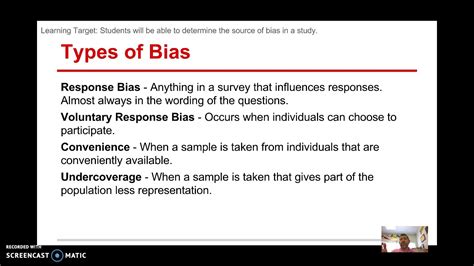
In AP Statistics, bias refers to any systematic error that can skew the results of a statistical analysis. Understanding different types of bias is crucial for drawing valid conclusions from data.
Types of Bias
Selection Bias
- Definition: Occurs when the sample is not representative of the population of interest.
-
Causes:
- Non-random sampling methods
- Participant characteristics that influence participation
- Example: A survey of students who attend a certain high school may not reflect the opinions of all students in the city.
Response Bias
- Definition: Occurs when respondents provide inaccurate or misleading answers.
-
Causes:
- Social desirability bias
- Acquiescence bias
- Interviewer effects
- Example: A survey about political preferences may produce results that differ from actual voting patterns due to respondents’ unwillingness to share their true views.
Observation Bias
- Definition: Occurs when the way data is collected influences the results.
-
Causes:
- Hawthorne effect
- Observer bias
- Example: A study of employee productivity may observe higher productivity when employees are aware of being observed.
Confounding Bias
- Definition: Occurs when another variable influences the relationship between two variables of interest.
-
Causes:
- A third variable that affects both of the variables in question
- Example: A study that finds a positive correlation between coffee consumption and heart disease may be confounded by the fact that both variables are influenced by age.
Sampling Bias
- Definition: Occurs when the sample is not randomly selected or representative of the population.
-
Causes:
- Sampling error
- Selection biases
- Example: A study that uses a self-selected sample of volunteers may overrepresent certain demographics.
Measurement Bias
- Definition: Occurs when the measuring instrument or method can systematically alter or misrepresent the data.
-
Causes:
- Flawed measuring instrument
- Data collection errors
- Example: A study that uses a biased questionnaire that favors certain responses.
Attrition Bias
- Definition: Occurs when participants drop out or are excluded from a study, potentially affecting the representativeness of the sample.
-
Causes:
- Voluntary dropout
- Non-response bias
- Example: A longitudinal study of health outcomes may have attrition bias if participants with poor outcomes are more likely to drop out.
Tips for Avoiding Bias
- Use random sampling methods.
- Minimize the impact of participant characteristics on participation.
- Train data collectors to be objective and unbiased.
- Control for confounding variables.
- Use validated and reliable measurement instruments.
- Minimize attrition rates.
FAQs
Q: How can I tell if a study may be biased?
A: Look for indicators of selection bias, response bias, observation bias, confounding bias, sampling bias, measurement bias, and attrition bias.
Q: What are the consequences of bias?
A: Bias can lead to inaccurate conclusions, invalid assumptions, and incorrect policy decisions.
Q: How can I reduce bias in my own research?
A: Use the tips provided in this article and follow accepted statistical practices.
Q: Is it possible to eliminate bias completely?
A: While it is impossible to eliminate bias entirely, it is possible to minimize its effects by using rigorous research methods.
Conclusion
Understanding and mitigating bias is essential in AP Statistics. By recognizing the different types of bias and implementing effective strategies to minimize their impact, researchers can ensure the validity and reliability of their statistical conclusions.