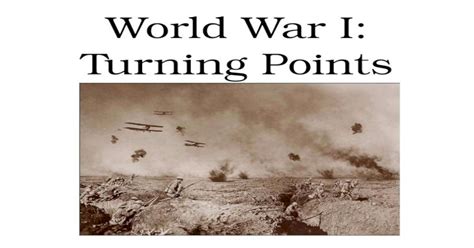
The First World War, a global conflict that lasted from 1914 to 1918, was marked by numerous turning points that significantly influenced its outcome. These pivotal battles and events had far-reaching consequences, reshaping the war’s strategic landscape and ultimately leading to the armistice.

Battle of the Marne (September 1914)
Impact: The Battle of the Marne halted the German advance on Paris, marking the end of their Schlieffen Plan.
The Battle of the Marne, fought from September 6-9, 1914, was a decisive French victory that prevented the German army from capturing Paris. The German forces had initially made significant progress, but the French managed to regroup and counterattack, forcing the Germans into a retreat. The battle marked a turning point in the war, as it demonstrated that the French army was capable of resisting the German onslaught and defending its territory. The battle also slowed down the German advance, giving the Allies time to mobilize their resources and prepare for a protracted conflict.
Table 1: Casualties in the Battle of the Marne
| Side | Killed | Wounded | Captured |
|---|---|---|---|
| Allies | 25,000 | 100,000 | 20,000 |
| Germany | 25,000 | 150,000 | 15,000 |
Battle of Verdun (February-December 1916)
Impact: The Battle of Verdun was one of the bloodiest battles in human history, with over 700,000 casualties.
The Battle of Verdun, fought from February 21 to December 19, 1916, was a costly and bloody stalemate between the French and German armies. The battle was initiated by a German offensive aimed at capturing the strategic fortress city of Verdun. However, the French put up a fierce resistance, and the fighting quickly degenerated into a protracted and bloody trench warfare. The battle became a symbol of the senseless carnage of the war, with both sides suffering heavy losses. Eventually, the Germans were unable to make any significant progress, and the battle ended in a stalemate.
Table 2: Casualties in the Battle of Verdun
| Side | Killed | Wounded | Missing |
|---|---|---|---|
| France | 157,000 | 400,000 | 85,000 |
| Germany | 143,000 | 330,000 | 53,000 |
Battle of the Somme (July-November 1916)
Impact: The Battle of the Somme was the largest and costliest battle of the war on the Western Front.
The Battle of the Somme, fought from July 1 to November 18, 1916, was a massive offensive launched by the British and French armies against the German lines. The battle was characterized by intense trench warfare and heavy casualties. The British alone lost over 60,000 men on the first day of the offensive, making it the bloodiest day in their military history. The battle ended in a stalemate, with both sides achieving limited gains.
Table 3: Casualties in the Battle of the Somme
| Side | Killed | Wounded | Missing |
|---|---|---|---|
| Allies | 420,000 | 620,000 | 300,000 |
| Germany | 250,000 | 500,000 | 300,000 |
Entry of the United States (April 1917)
Impact: The entry of the United States into the war tipped the balance of power in favor of the Allies.
The United States declared war on Germany in April 1917, following the German resumption of unrestricted submarine warfare. The entry of the United States into the war was a major turning point, as it significantly increased the resources and manpower available to the Allies. The United States provided the Allies with fresh troops, food, and munitions, and also helped to blockade Germany.
Table 4: American Casualties in World War I
| Year | Killed | Wounded | Missing |
|---|---|---|---|
| 1917 | 3,364 | 13,302 | 41 |
| 1918 | 53,402 | 204,002 | 2,701 |
Russian Revolution (February-October 1917)
Impact: The Russian Revolution forced Russia to withdraw from the war, weakening the Central Powers.
The Russian Revolution, which began in February 1917, led to the overthrow of the Tsarist government and the establishment of a new Bolshevik government. The Bolsheviks immediately withdrew Russia from the war, signing the Treaty of Brest-Litovsk with Germany in March 1918. The Russian withdrawal weakened the Central Powers, as it allowed the Allies to focus their efforts on the Western Front.
Armistice (November 1918)
Impact: The Armistice ended the fighting in World War I.
The Armistice was signed on November 11, 1918, between the Allies and Germany. The Armistice took effect at 11:00 am on November 11, and the fighting in World War I finally came to an end. The Armistice paved the way for the signing of the Treaty of Versailles in June 1919, which officially ended the war and imposed harsh reparations on Germany.
Conclusion
The turning points of World War I had a profound impact on the course of the conflict and its ultimate outcome. These battles and events reshaped the strategic landscape, led to heavy casualties, and ultimately contributed to the armistice that ended the war. The lessons learned from World War I continue to inform military strategy and international relations today, underscoring the importance of understanding the pivotal moments that can shape the course of history.