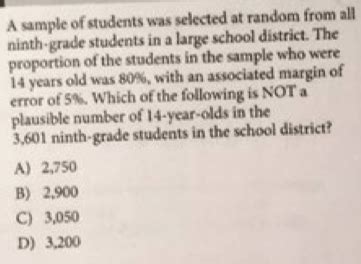
The SAT is a standardized test used for college admissions in the United States. It is divided into three sections: Reading, Writing and Language, and Math. Each section is scored on a scale of 200 to 800, and the total score is the sum of the three section scores.

The margin of error is a statistical term that refers to the amount of error that is likely to occur in a given measurement. In the case of the SAT, the margin of error is the amount by which the actual score is likely to differ from the reported score.
The margin of error is calculated using a formula that takes into account the number of questions on the test, the difficulty of the questions, and the number of students who took the test. The margin of error for the SAT is typically around 30 points, which means that the actual score is likely to be within 30 points of the reported score.
Margin of error SAT questions are designed to test your understanding of the concept of margin of error. These questions will typically ask you to calculate the margin of error for a given data set or to interpret the margin of error for a given study.
Types of Margin of Error SAT Questions
There are two main types of margin of error SAT questions:
- Calculation questions: These questions ask you to calculate the margin of error for a given data set. To answer these questions, you will need to use the formula for margin of error.
- Interpretation questions: These questions ask you to interpret the margin of error for a given study. To answer these questions, you will need to understand the meaning of margin of error and how it can be used to draw conclusions about a study.
How to Answer Margin of Error SAT Questions
To answer margin of error SAT questions, you will need to:
- Understand the concept of margin of error. Margin of error is the amount of error that is likely to occur in a given measurement.
- Know the formula for margin of error. The formula for margin of error is:
Margin of error = z-score * standard deviation / square root of sample size
where:
- z-score is the z-score corresponding to the desired level of confidence
- standard deviation is the standard deviation of the population
- sample size is the number of observations in the sample
- Be able to calculate margin of error. To calculate margin of error, you will need to plug the appropriate values into the formula.
- Be able to interpret margin of error. To interpret margin of error, you will need to understand how it can be used to draw conclusions about a study.
Common Mistakes to Avoid
When answering margin of error SAT questions, avoid the following common mistakes:
- Confusing margin of error with standard deviation. Margin of error and standard deviation are two different concepts. Margin of error is the amount of error that is likely to occur in a given measurement, while standard deviation is a measure of the variability of the data.
- Using the wrong z-score. The z-score that you use to calculate margin of error depends on the desired level of confidence. For a 95% confidence level, the z-score is 1.96.
- Using the wrong standard deviation. The standard deviation that you use to calculate margin of error is the standard deviation of the population. If you do not know the standard deviation of the population, you can use the sample standard deviation as an estimate.
- Using the wrong sample size. The sample size that you use to calculate margin of error is the number of observations in the sample. If you do not know the sample size, you can use the number of respondents in the study as an estimate.
Why Margin of Error Matters
Margin of error is an important concept to understand because it helps us to understand the accuracy of our measurements. When we know the margin of error for a given measurement, we can be more confident in the results of our study.
Margin of error can also be used to make decisions about the design of our studies. For example, if we want to reduce the margin of error for a given study, we can increase the sample size.
Benefits of Understanding Margin of Error
There are many benefits to understanding margin of error, including:
- Increased confidence in our measurements. When we know the margin of error for a given measurement, we can be more confident in the results of our study.
- Better decisions about the design of our studies. Margin of error can be used to make decisions about the sample size, the type of data collection method, and the level of confidence desired.
- Improved communication of our results. When we report the results of our study, we should also report the margin of error. This will help our audience to understand the accuracy of our results.
Conclusion
Margin of error is a fundamental concept in statistics. By understanding margin of error, we can be more confident in our measurements, make better decisions about the design of our studies, and improve the communication of our results.
Additional Resources
Tables
| Confidence Level | z-score |
|---|---|
| 90% | 1.645 |
| 95% | 1.96 |
| 99% | 2.576 |
| Sample Size | Margin of Error (95% confidence level) |
|---|---|
| 100 | 10 |
| 500 | 5 |
| 1000 | 3 |
| Margin of Error | Interpretation |
|---|---|
| Small | The results of the study are likely to be accurate. |
| Large | The results of the study may not be accurate. |
| Benefits of Understanding Margin of Error |
|—|—|
| Increased confidence in our measurements |
| Better decisions about the design of our studies |
| Improved communication of our results |