Introduction

Physics 1 dynamics unit is the cornerstone of classical mechanics, providing a comprehensive understanding of motion and forces. This introductory module delves into the fundamental principles that govern how objects move and interact, laying the groundwork for further exploration in physics.
1.1 Displacement, Velocity, and Acceleration
- Displacement: The change in an object’s position, denoted by the symbol Δx.
- Velocity: The rate of change in displacement, or the speed and direction of an object’s motion, represented by the symbol v.
- Acceleration: The rate of change in velocity, indicating the change in an object’s motion, denoted by the symbol a.
1.2 Equations of Motion
The three equations of motion in one dimension relate displacement, velocity, acceleration, and time:
- Δx = v0t + 1/2at²
- v = v0 + at
- v² = v0² + 2aΔx
2.1 Force:
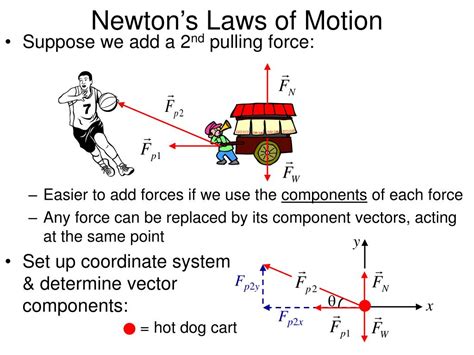
A force is a push or pull that can cause an object to change its motion. The SI unit of force is the newton (N).
2.2 Newton’s First Law (Law of Inertia):
An object at rest will remain at rest, and an object in motion will remain in motion at constant speed and in a straight line unless acted upon by an external force.
2.3 Newton’s Second Law (Law of Acceleration):
The acceleration of an object is directly proportional to the net force acting on it and inversely proportional to its mass. The equation is expressed as:
F = ma
2.4 Newton’s Third Law (Action-Reaction Law):
For every action, there is an equal and opposite reaction.
3.1 Work:
Work is the transfer of energy to or from an object due to a force acting over a distance. The SI unit of work is the joule (J).
3.2 Energy:
Energy is the ability to do work. The SI unit of energy is the joule (J).
3.3 Work-Energy Theorem:
The net work done on an object is equal to the change in its kinetic energy.
4.1 Momentum:
Momentum is a measure of an object’s motion. It is defined as the product of an object’s mass and velocity. The SI unit of momentum is the kilogram meter per second (kg m/s).
4.2 Law of Conservation of Momentum:
The total momentum of a closed system (no external forces acting) remains constant.
The principles of dynamics are ubiquitous in our daily lives and have revolutionized various industries and technologies:
1. Vehicular Motion:
Dynamics governs the motion of vehicles, enabling us to understand acceleration, braking, and stability.
2. Robotics:
The manipulation of robotic arms and the motion of robots are dictated by the laws of dynamics.
3. Sports Science:
Dynamics plays a crucial role in analyzing and improving performance in sports, including projectile motion, acceleration, and momentum.
4. Aerospace Engineering:
Rocket propulsion, satellite motion, and orbital mechanics rely heavily on the principles of dynamics.
5. Biomedical Engineering:
Understanding dynamics is essential for designing prosthetics, analyzing human movement, and developing medical imaging techniques.
Conclusion
The physics 1 dynamics unit provides a solid foundation for understanding the laws of motion and the behavior of objects under various forces. Its applications extend far beyond academic settings, shaping numerous fields and technologies that enhance our lives. As we continue to explore the realm of physics, the principles of dynamics will undoubtedly continue to guide our understanding of the physical world.